No products in the cart.
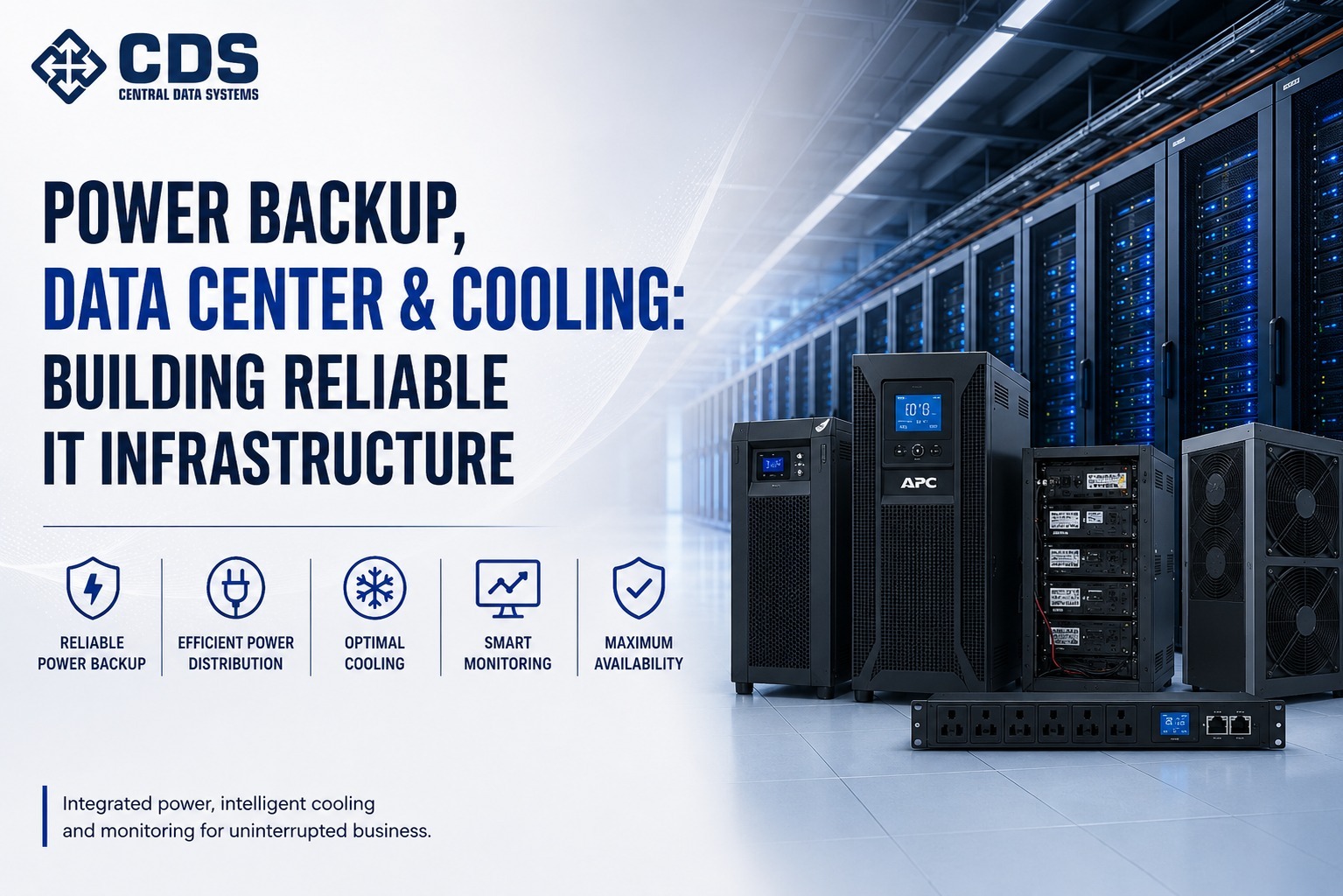
Modern businesses rely heavily on digital infrastructure. Servers, networking equipment, storage systems, applications, communication platforms and cloud-connected devices support everything from daily operations to customer services.
But reliable IT infrastructure is not only about installing high-performance servers and networking equipment. The environment supporting those systems is equally important.
Power backup, power distribution, cooling, environmental monitoring and preventive maintenance all contribute to the reliability of a data center or server room.
A power outage can stop critical systems within seconds. Voltage fluctuations can affect sensitive equipment, while excessive heat can impact equipment performance and reduce component life. For this reason, businesses need to look at their data center infrastructure as an integrated system rather than treating power and cooling as separate requirements.
Electricity is the foundation of any data center.
Servers, storage systems, switches, routers, firewalls and other IT equipment require stable power to operate continuously. Even a short interruption can cause equipment shutdowns, application failures, connectivity issues and operational disruption.
This is where an Uninterruptible Power Supply (UPS) becomes an important part of data center power infrastructure.
A UPS provides backup power when the primary electrical supply fails. Depending on the UPS technology and configuration, it can also help protect connected equipment against power-quality problems such as voltage fluctuations, surges and electrical disturbances.
For critical IT environments, online double-conversion UPS systems are commonly considered because they continuously condition the incoming power before supplying it to connected equipment.
Central Data Systems currently offers APC online UPS solutions across single-phase and three-phase categories, including systems intended for servers, networking equipment, data centers and other critical applications.
Choosing a UPS should not simply be based on the highest available capacity.
The system should be selected according to the actual electrical load and future requirements of the environment.
Important considerations include:
For example, a small server room may require a single-phase online UPS, while a large enterprise data center may require multiple high-capacity three-phase UPS systems.
Central Data Systems current product range includes three-phase APC UPS systems from smaller capacities through high-capacity solutions, providing options for different enterprise and infrastructure requirements.
A UPS protects the incoming power supply, but the electricity still needs to be distributed efficiently to the equipment.
This is where Power Distribution Units (PDUs) become important.
A PDU distributes electrical power to equipment installed within a rack or cabinet. Depending on the model, PDUs may also provide metering, switching and remote monitoring capabilities.
For data center operators, rack-level power visibility can be valuable because it helps teams understand how electrical capacity is being consumed.
Central Data Systems currently offers APC rack PDUs, including metered and switched PDU options for IT and data center environments.
Data center availability can also depend on having more than one power source.
An Automatic Transfer Switch (ATS) can automatically transfer a connected load between available power sources when the primary source becomes unavailable or falls outside acceptable operating conditions.
This can be useful in environments where redundant power sources are part of the infrastructure design.
For example, an ATS can help support power availability for selected equipment by switching between two independent sources.
Central Data Systems currently lists APC rack ATS solutions designed for redundant power management in server rooms, data centers and networking environments.
Power is not the only infrastructure challenge.
IT equipment generates heat continuously while operating. Servers, storage systems, networking equipment and power infrastructure all contribute to the heat load within a server room or data center.
If heat is not removed effectively, room temperature can increase beyond the recommended operating conditions for the equipment.
Excessive heat can contribute to:
This makes data center cooling a critical component of infrastructure planning.
Installing an air-conditioning unit is not necessarily the same as designing an effective server room cooling strategy.
Airflow management is equally important.
Equipment should be arranged so that cool air reaches the equipment intake while hot exhaust air is effectively removed. In larger environments, rack arrangement, airflow containment and cooling capacity need to be considered as part of the overall design.
The cooling requirement should also account for the actual heat generated by the IT equipment and supporting infrastructure.
As computing loads increase, cooling requirements can increase as well.
Cooling systems should not operate without visibility into environmental conditions.
Temperature and humidity sensors can help IT and facility teams identify abnormal conditions before they become serious problems.
For example, a temperature increase in a server room could indicate a cooling problem, blocked airflow, equipment overload or an HVAC issue.
Central Data Systems currently offers APC temperature and humidity monitoring products, including AP9335TH and AP9335T sensor options.
One of the most important points businesses should understand is that power and cooling are interconnected.
A UPS itself produces heat while operating. Servers and networking equipment also generate heat. Therefore, increasing the amount of IT equipment or power infrastructure can increase the cooling requirement.
This means that data center planning should consider both sides of the equation.
A simple infrastructure model can be viewed as:
Power Source → UPS → Power Distribution → IT Equipment → Heat Generation → Cooling → Environmental Monitoring
Each part supports the reliability of the next.
If the power system is reliable but the cooling system fails, the IT infrastructure can still be affected.
Similarly, excellent cooling cannot prevent downtime if the electrical supply is unstable and there is no adequate backup power.
Modern IT environments increasingly require visibility into infrastructure health.
UPS monitoring can provide information about operating conditions, load, battery status and potential alerts, depending on the UPS and monitoring configuration.
Network management and monitoring technologies can help IT teams identify issues without having to physically inspect equipment.
This becomes particularly useful for large data centers and distributed infrastructure where manual monitoring is difficult.
The UPS itself is only as effective as its battery backup system.
A UPS may appear to operate normally during everyday conditions while having degraded batteries that cannot provide the expected backup runtime during an actual outage.
Battery age, operating temperature, charging conditions, usage patterns and maintenance can all influence battery performance.
This is why organizations should include battery inspection and replacement within their infrastructure maintenance strategy.
Central Data Systems provides UPS battery replacement services as part of its infrastructure support offering.
Buying a UPS is not the end of the power protection process.
Regular maintenance can help identify potential issues before they result in downtime.
A preventive maintenance program may include inspection of:
For businesses operating critical infrastructure, UPS AMC can provide an additional layer of ongoing support.
Central Data Systems offers UPS AMC services, along with installation, battery replacement, rental and extended warranty services.
A dependable data center requires more than a powerful UPS or an effective cooling system.
The complete infrastructure should be planned around:
Power Backup + Power Distribution + Redundancy + Cooling + Monitoring + Maintenance
Businesses should assess their current infrastructure and identify where a failure could create the greatest operational impact.
For a new server room, this planning should happen before equipment installation.
For an existing data center, organizations can assess current UPS capacity, battery condition, power distribution, cooling performance and environmental monitoring to identify potential gaps.
Reliable IT infrastructure depends on multiple systems working together.
Data center power backup helps protect critical equipment against electrical interruptions. PDUs support effective rack-level power distribution, while ATS solutions can help provide redundant power switching. Cooling systems manage the heat generated by IT infrastructure, and temperature and humidity sensors provide visibility into environmental conditions.
Regular UPS maintenance, battery replacement and infrastructure monitoring then help support long-term reliability.
For businesses planning a new server room, upgrading their data center or improving business continuity, the right combination of UPS, power distribution, monitoring and support services can provide a stronger foundation for reliable IT operations.
Central Data Systems provides APC UPS products, power distribution solutions, monitoring accessories and UPS-related services to help businesses build and maintain dependable power infrastructure.

Leave a comment